
A dental marketing plan only works if someone executes it. The seven elements that turn a document into a system: SWOT, SMART goals, budget, KPIs.
70% of dental marketing plans that land on our desk share the same problem: they are well-written documents that nobody executes. They don't fail on strategy. They fail because they miss the five elements that turn a document into a system: an honest diagnosis of the starting point, measurable goals with a deadline, a budget allocation by channel, a named owner for every action, and a monthly tracking system with real metrics (new patient consultations, accepted treatment plans, patient acquisition cost). A marketing plan for a dental practice is the roadmap that connects your current situation with your growth goals, translated into concrete actions, a calendar and a budget. If your plan doesn't answer three questions (where am I, where do I want to go, what do I do each month to get there), it's a decorative document.
Step 1: Diagnosis with a SWOT analysis applied to your practice
Before deciding what to invest in, you need to know your starting point. A SWOT analysis (Strengths, Weaknesses, Opportunities, Threats) is the tool that gives you that snapshot.
Applied to a dental practice, the SWOT works across four quadrants:
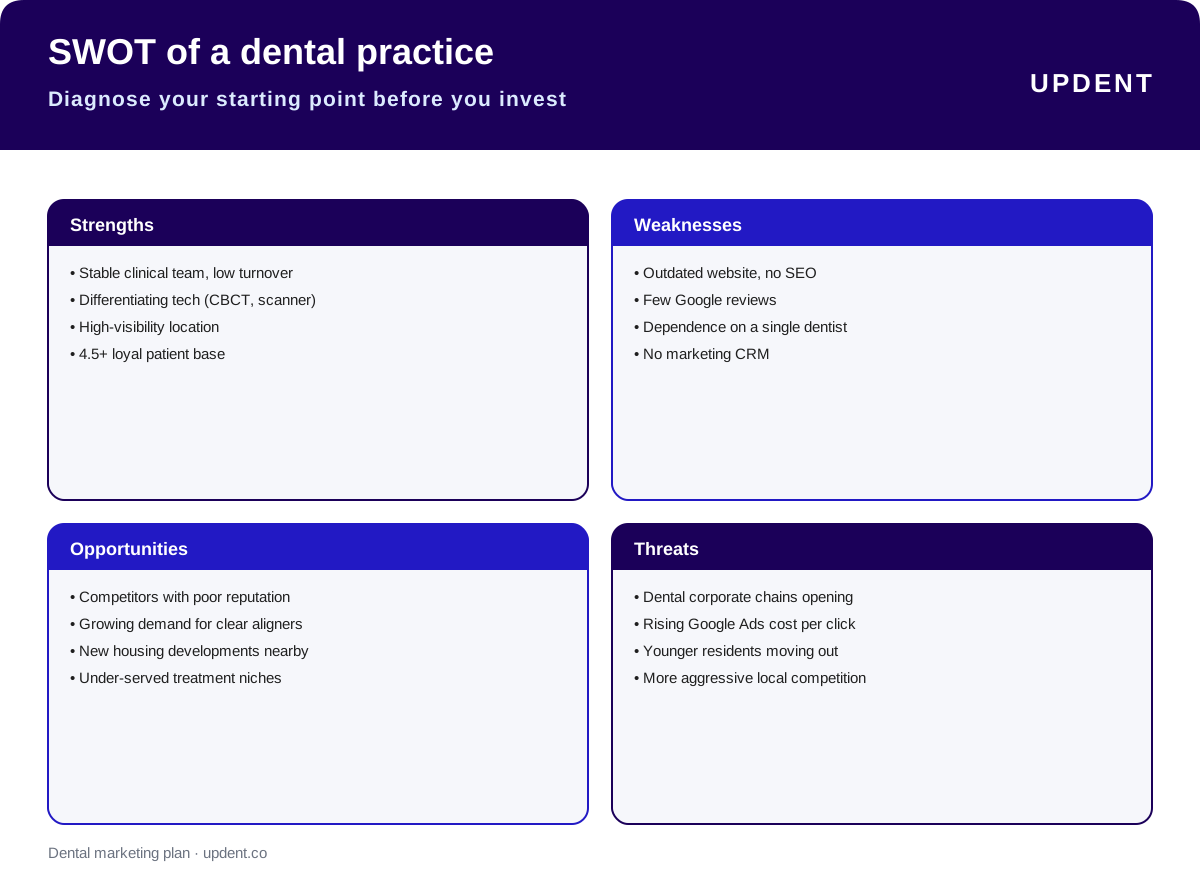
Strengths (internal, positive): what already works. Real examples in practices: a stable clinical team with low turnover, differentiating technology (CBCT, intraoral scanner), a high-visibility high-street location, a loyal patient base averaging more than 4.5 on Google, specialisation in high-value treatments such as implants or cosmetic dentistry.
Weaknesses (internal, negative): what holds you back. The most common ones: an outdated website with no SEO optimisation, few reviews on Google or your NHS Find a Dentist listing, dependence on a single dentist for billing, a front desk with no treatment-plan follow-up protocol, the absence of a marketing CRM (a system that records where each patient came from and what happens to them after the first contact).
Opportunities (external, positive): what the market offers you. Examples: competitors with a poor online reputation in your area, growing demand for clear aligners among adults, new housing developments near your practice, under-served treatment niches in your city.
Threats (external, negative): what can complicate things. The opening of dental corporate chains in your area, a rising cost per click on Google Ads in your city, younger residents moving out of the neighbourhood.
In our article on SWOT analysis for dental practices we develop it with a full real example. The key point here is that the SWOT shouldn't be a theoretical exercise: each point must translate into a concrete action within the plan.
Step 2: Set your goals with the SMART method
A SMART goal is one that is Specific, Measurable, Achievable, Relevant and Time-bound. Without these five criteria, a goal is just a wish.
The difference in practice:
Vague goal: "I want more implant patients." SMART goal: "Increase implant consultations from 8 to 15 a month over the next 6 months, with a patient acquisition cost (what it costs to get a patient into the chair) below £130."
Vague goal: "Improve our presence on Google." SMART goal: "Enter Google's local pack (the top three results on Maps) for the search 'dentist + [my city]' within 4 months."
Vague goal: "Get more reviews." SMART goal: "Go from 32 to 80 Google reviews in 90 days, keeping an average of 4.7 or higher."
Set between 3 and 5 annual SMART goals. More than five becomes unmanageable if you don't have a dedicated marketing team. Each goal must have an owner inside the practice (it can't all fall on the principal) and a monthly tracking metric.
Step 3: Define your ideal patient (buyer persona)
A buyer persona is the semi-fictional profile of your ideal patient: not the average patient, but the one you most want to attract because they generate the greatest value for your practice.
Building it means answering: how old are they, what treatment do they need, how do they search for a dentist (Google, referral, social media), what worries them before calling (price, pain, trust), what would make them choose your practice over the one next door.
A concrete example:
"Marta, 52." A director at a mid-sized company. She lost a molar three years ago and has kept putting off the implant. She searches on Google from her phone, reads reviews before calling, compares quotes from 2-3 practices. She worries about pain and price, but values trust and technology more. She decides at the first appointment whether to accept the treatment plan.
Knowing exactly who your ideal patient is changes how you write your website, what ads you create, what content you publish on social media and how your front desk handles the first call. Without a defined persona, all the marketing is generic. And generic doesn't convert.
Step 4: A three-layer channel strategy
With the diagnosis, the goals and the ideal patient defined, choosing channels gets simpler. The structure always follows the same order of priority, because each layer depends on the one before it.
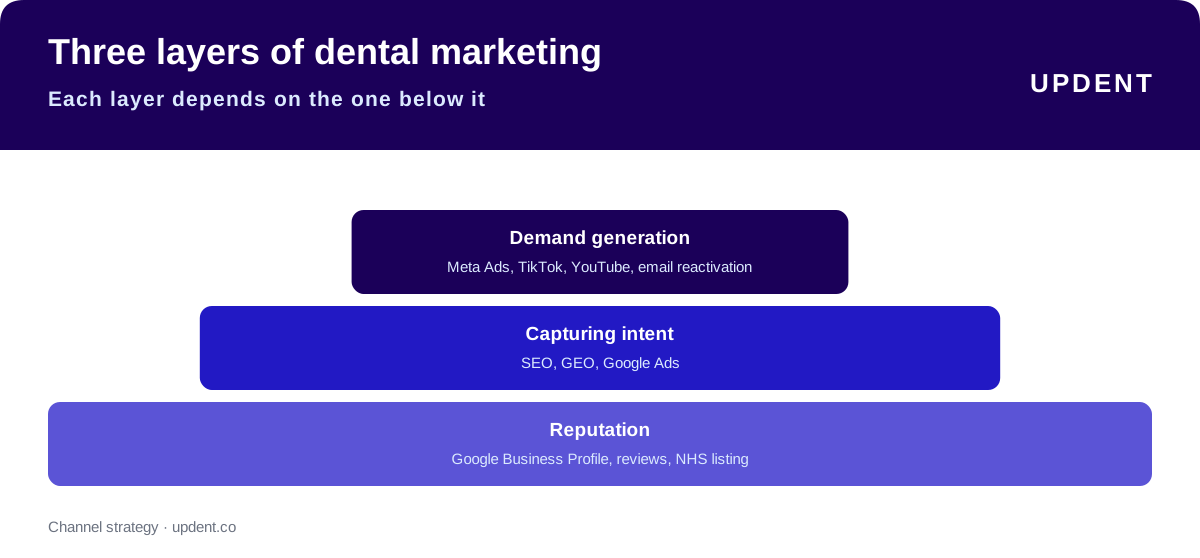
Layer 1: Reputation (the foundation)
Before investing in attracting patients, your online reputation has to be in order. A patient who finds you through Google Ads and sees 12 reviews averaging 3.8 isn't going to call.
Concrete actions: optimise your Google Business Profile with professional photos, correct opening hours and a reply to every review. Put an active review-generation system in place (NFC cards, post-visit WhatsApp, automated email). Create or improve your NHS Find a Dentist listing.
Cost: £80 to £250 a month in tools, plus your team's time.
Layer 2: Capturing intent (patients already searching)
These channels capture people who are actively searching for a dentist or a treatment. They are the ones that generate new consultations fastest.
SEO (search engine optimisation). The channel with the lowest CPL (cost per qualified contact) over the medium and long term: between £4 and £20 per contact. It takes 3-6 months to consolidate, but it generates a steady, predictable flow. Well-executed SEO for dental practices is the most profitable marketing asset.
GEO (optimisation for AI). Appearing in answers from ChatGPT, Gemini and Perplexity is no longer optional. It shares foundations with SEO but requires content with explicit definitions and verifiable data.
Google Ads. Results from the first week. CPL varies by treatment: implants £35-100, orthodontics £20-60, emergencies £4-12. In our Google Ads guide for dentists we explain how to structure campaigns by treatment.
Layer 3: Demand generation (patients not searching yet)
These channels reach people who match your ideal patient profile but aren't looking for a dentist right now.
Meta Ads (Facebook and Instagram). Especially effective for cosmetic treatments and clear aligners. CPL in the UK: £13-50. They need a more structured follow-up process because the patient had no prior intent. In our Facebook Ads guide for dental practices we detail how to create campaigns that convert.
TikTok and YouTube. Emerging channels in dental with a still-low cost per impression. They work well to build brand and trust before the patient needs treatment.
Email marketing and reactivation. The channel with the highest ROI (return on investment) in the dental sector: between 15:1 and 50:1. Inactive-patient reactivation campaigns by email and WhatsApp tap into trust that already exists.
Step 5: Allocate budget by channel
A dental practice's marketing budget should sit between 5% and 10% of its gross monthly revenue. In our article on dental marketing budget we break it down by practice size.
As a reference for a 2-3 surgery practice with £35,000 of monthly revenue (indicative budget: £1,800-3,500 a month):
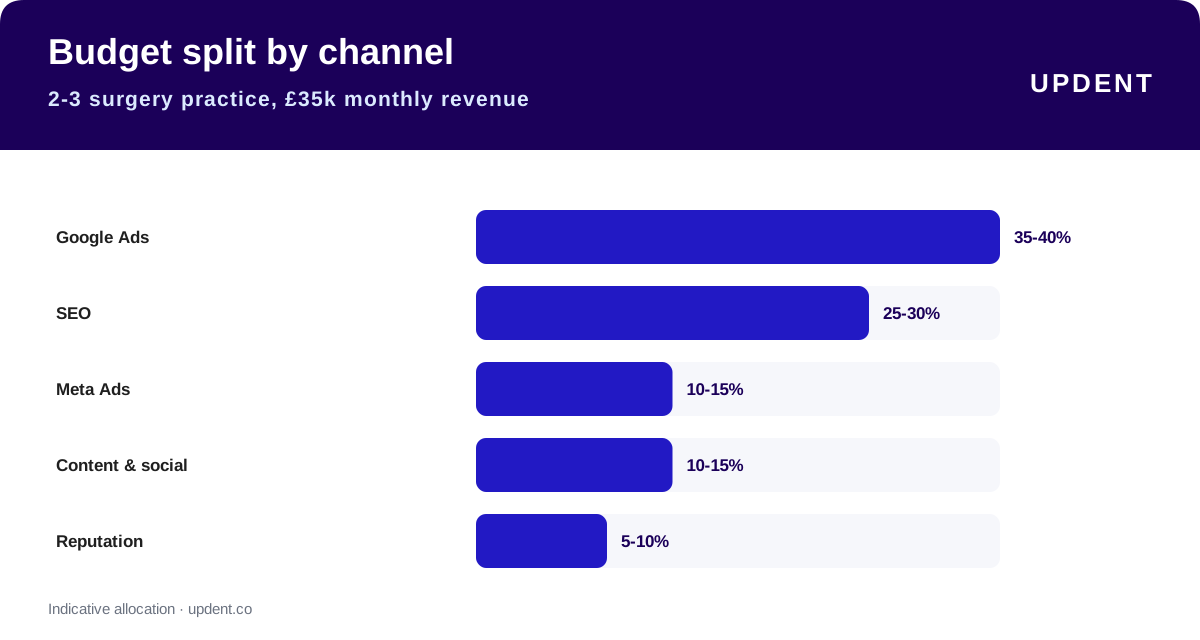
| Channel | Monthly investment | % of budget | Expected result |
|---|---|---|---|
| Google Ads | £700 to £1,300 | 35-40% | 15-30 qualified contacts |
| SEO (agency or freelance) | £450 to £900 | 25-30% | Medium-term ranking |
| Meta Ads | £180 to £450 | 10-15% | Visibility + cosmetic leads |
| Reputation management | £80 to £250 | 5-10% | More reviews, better conversion |
| Email/WhatsApp marketing | £40 to £130 | 3-5% | Inactive-patient reactivation |
| Content and social media | £180 to £450 | 10-15% | Brand and trust |
This split isn't fixed. After the first month of data, redistribute according to results: if Google Ads generates new consultations at £55 and Meta Ads at £160 for the same treatment, reallocate budget towards what works.
Step 6: Editorial and campaign calendar
A plan without a calendar doesn't get executed. The calendar has two layers.
Recurring layer (every month):
Blog: 2 articles a month with a publication date and an assigned owner. Each article targets a keyword from the SEO content plan.
Social media: 3-4 posts a week. The mix that works best in dental: 1 educational (treatment explained), 1 social proof (before/after with consent, a featured review), 1 team/practice (humanises the brand). Our social media guide for dental practices details what to post and how often.
Email: 1 monthly newsletter with valuable content + automations (welcome, post-visit, six-month check-up reminder, inactive-patient reactivation).
Seasonal layer (campaigns by season):
| Period | Opportunity | Suggested campaign |
|---|---|---|
| January | New Year resolutions | "Start the year caring for your smile" |
| March-April | Post-Easter break | Hygiene appointments and check-ups |
| June-July | Pre-summer | Whitening and cosmetic dentistry |
| September | Back to school | Children's orthodontics and check-ups |
| November | Pre-Christmas | Free assessment consultation |
Each seasonal campaign is planned 3-4 weeks in advance: creatives, a landing page if applicable, ad setup and a briefing for the front desk so they know what questions to expect.
Step 7: Define your KPIs and monthly tracking system
KPIs (key performance indicators) are the metrics that tell you whether the plan is working or not. Without monthly tracking, the plan dies in the second week.
These are the KPIs every practice investing in marketing should measure:
New consultations attributed to marketing (by channel). The headline metric. How many new patients reach the chair thanks to each channel. If you can't attribute a first consultation to its source, you need a marketing CRM.
Real patient acquisition cost (by channel and treatment). Investment in the channel divided by the consultations it generates. The figure that governs every budget decision.
Front desk conversion rate. The percentage of contacts that become a booked first consultation. The metric with the biggest impact on marketing profitability and the one fewest practices measure.
Treatment-plan acceptance rate. If patients arrive but few accept, the problem may be in how the treatment plan is presented in the practice, not in the marketing.
ROI by channel. Pounds billed for every pound invested. Indicative benchmarks in the UK: SEO 8:1-20:1, Google Ads 3:1-10:1, email reactivation 15:1-50:1, Meta Ads 2:1-7:1.
New reviews per month. An indicator that the review-generation system is working.
Schedule a 30-45 minute meeting each month to review these KPIs. If a channel misses its target for two consecutive months, adjust: change the strategy, reallocate budget or investigate whether the problem is in the channel or in the internal conversion process.
The 5 mistakes that leave a dental marketing plan in a drawer
After reviewing marketing plans from dozens of practices, these are the ones that recur most:
1. A plan with no owner. If there's no specific person (internal or external) executing each action and accountable for it, the plan doesn't move forward. You don't need a marketing team: you need one person who dedicates time each week.
2. Goals with no numbers. "More patients" isn't a goal. "15 implant consultations a month before June" is. Without numbers there's no way to know if the plan is working.
3. All the budget on a single channel. Putting 100% into Google Ads and nothing into reputation or SEO is a risk. If Google raises prices or a competitor moves in with a bigger budget, you're left with no alternative. Diversify by following the three layers.
4. Not measuring real acquisition cost. Measuring leads or contacts without knowing how many reach the chair is like measuring rainfall without checking whether the water reaches the crop. The figure that matters is the cost of the first consultation, not the cost of the contact.
5. Ignoring what happens after the contact. The marketing plan doesn't end when the phone rings. If your front desk doesn't answer within the first 30 seconds, if nobody follows up on pending treatment plans, if there's no re-contact protocol, the most brilliant plan in the world generates contacts that get lost. The internal conversion side is the invisible half of the plan.
These dental marketing mistakes are the most expensive because they don't look like marketing mistakes: they look like management problems. But they are two sides of the same coin.
Conclusion: a plan that gets executed is worth more than a perfect one
A dental marketing plan doesn't need to be a 40-page document. It needs seven things: an honest SWOT, 3-5 SMART goals, a defined ideal patient, a three-layer channel strategy, an allocated budget, a calendar with owners and a monthly tracking system with real KPIs.
If your practice already invests in marketing but has no structured plan, or has one that nobody reviews, the first step is to diagnose where you are. Request your free audit and in 30 minutes we'll show you your current situation, where your investment is leaking and what action plan you need so every pound translates into a full appointment book. No commitment.
Frequently Asked Questions
A complete dental marketing plan includes a SWOT analysis of the practice, SMART goals (specific, measurable, achievable, relevant and time-bound), a defined ideal patient, a channel strategy organised in three layers (reputation, capturing intent and demand generation), a budget allocated by channel, an editorial and campaign calendar, and a monthly tracking system with KPIs such as new consultations, acquisition cost and front desk conversion rate.

José Ramón Díaz
+10 años de experiencia en Marketing y Startups especializado en el sector Salud y Dental. Ex-DR SMILE e Impress.
Want us to implement
this in your practice?
Book your free audit and we'll show you exactly how to grow.
Talk to a Strategist