
How dental SEO works in 2026: AI Overviews on treatment queries, local search untouched by AI, and the strategy for each. With real UK examples.
SEO for dental practices has changed more between 2025 and 2026 than in the previous five years combined. Not because Google has scrapped organic ranking, but because it has split the results map into two zones that run on completely different logic.
According to BrightEdge, 100% of queries about dental treatments and procedures already show an AI Overview as of December 2025. That means when a patient searches "what is a dental implant" or "how much does orthodontics cost", Google generates an answer before showing them a single link.
But there is an equally important fact that almost nobody in the sector has read yet: Google removed AI Overviews entirely from local-intent searches, the "dentist near me" or "dental practice London" queries. It tested them, then pulled them. The Maps 3-pack and local organic results remain the only direct patient-acquisition channel, with no AI in between.
What has changed is the right strategy for each type of content. This guide explains it with real data and examples from UK practices.
What is SEO for dental practices in 2026?
SEO for dental practices is the set of actions that get your practice into the top results when a patient searches "dentist in London", "dental implants Manchester" or "adult orthodontics Birmingham", and that get your content cited as a source when an AI answers questions about dental treatments.
The second half of that definition did not exist in 2025. Today it matters just as much as the first.
The structural foundation has not changed: the dental sector is YMYL (Your Money or Your Life), the category Google uses for sites whose content can affect people's health or finances. For these sites, the E-E-A-T criteria (Experience, Expertise, Authoritativeness and Trustworthiness) are stricter than in any other sector. What has changed is that those criteria now also determine whether an AI cites you or ignores you, not just whether Google ranks you.
For a dental practice, demonstrating E-E-A-T in 2026 still requires a team page with visible qualifications, content signed by the dentist author with their GDC registration number, verifiable contact information and genuine patient reviews. On top of that comes a new element: consistency of information across your website, your Google Business Profile, your NHS Find a Dentist listing and the relevant dental directories. Without that consistency, generative AI systems don't have enough signals to identify you as a trustworthy source.
Why is dental SEO still different from normal SEO in 2026?
Four structural differences that in 2026 have sharpened, not softened.
First: the search intent of the dental patient remains the most active in the local services sector.
When someone types "dental implant cost London" they are not researching. They have a problem, they have been putting off the solution for a while, and they are ready to call. The conversion rate of these searches is among the highest in any local services sector. Every position gained in Google has a direct financial impact.
Second: the intent map has split into three even more distinct phases.
Phase 1 (informational): "what is a dental implant", "what is invisible orthodontics like". Here AI Overviews dominate. The goal is no longer to rank in position 1, but to be cited as a source within the summary Google generates.
Phase 2 (comparison): "best implant practices London prices", "invisible orthodontics comparison London". Here AI Overviews coexist with organic results. Presence in directories such as Google Business Profile and dental directories remains critical because AIs use them as a source.
Phase 3 (local decision): "dental practice Islington London", "dentist near me open now". Here Google Maps and the local 3-pack remain the only channel, with no AI in between. This is the zone of direct patient acquisition.
Third: competition on generic searches is still impossible to win head-on.
For "dental implants London" you are competing with NHS listings, large directory sites and corporate dental groups with years of accumulated authority. The smart strategy runs through the keywords where those platforms are not optimised: hyper-specific local searches (neighbourhood name + treatment) and comparison searches the directories don't work on.
Fourth: regulatory restrictions have not changed, but the risk of breaching them is now higher.
You cannot claim you are "the best practice in London". You cannot guarantee a treatment outcome. You cannot use patient testimonials without explicit, written consent. Breaches can lead to action by the General Dental Council (GDC) or, for advertising claims, the Advertising Standards Authority (ASA). A dental SEO who doesn't know these limits is a risk to the practice, not an asset.
SEO ranking factors for dental practices in 2026
The factors that move the result in 2026 are the same as always, with a new layer on top: visibility in AI Overviews.
On-page SEO
Title tag: the highest-impact on-page factor and the easiest to change. Each page needs a unique title with the main keyword and the practice name. A format that works: Treatment + City + Differentiator | Practice name. Example: "Dental Implants in Manchester | Same-Day Implants | Practice X".
Meta description: not a direct ranking factor, but it affects CTR. In 2026 it matters more because when an AI Overview occupies the top of the SERP, your organic result has to work harder to earn the click. A well-written meta description can recover part of the CTR lost to the AI.
Content per treatment: each main treatment needs its own page of 800 to 1,500 words. Not one "services" page with a paragraph for each. This hasn't changed, but in 2026 the informational content of those pages also determines whether the AI cites you when a patient asks about that treatment on Google, ChatGPT or Perplexity.
Explicit authorship signals: the name of the dentist author, their GDC registration number and a link to their profile on the page are E-E-A-T signals that AIs weigh when deciding whether to cite a source. Without visible authorship, the probability of appearing in an AI Overview drops.
Technical SEO
Core Web Vitals: the three metrics Google uses to measure user experience are LCP (load speed of the main element), CLS (visual stability) and INP (responsiveness to interactions). You can measure them free in Google Search Console or PageSpeed Insights. The average dental practice in the UK has speed problems in 70% of cases, which is a direct disadvantage against those whose site is optimised.
Mobile-first indexing: Google ranks your site based on the mobile version. If your site is perfect on desktop but chaotic on mobile, your ranking suffers.
Structured schema markup: in 2026 it is no longer optional. It is the language AIs use to understand what your practice is, which treatments it offers and where it is. Without it, generative AIs don't have enough structure to cite you accurately. The essential schemas are DentistOffice, MedicalProcedure for each treatment, and FAQPage. They are explained in detail further down.
Local SEO
Local SEO is still the most important part of dental SEO, and in 2026 Google has reaffirmed that searches with physical-visit intent are the exclusive territory of the Maps pack and local organic results, with no AI in between.
The Google Business Profile is the listing that appears in Google Maps. Optimising it well can take you into the local 3-pack, which appears above all organic results and captures between 40% and 70% of clicks on searches with appointment intent.
Reviews are the number 1 conversion factor. A practice with 4.7 stars and 90 reviews consistently converts better than one with 5 stars and 8 reviews. More reviews, more recent and more varied, is also the signal AIs read as verifiable social proof.
Off-page
Domain authority is built with inbound links from relevant sites. In dental, the most valuable come from reputable health and dental directories, your local NHS listings ecosystem and the local press. You don't need thousands of links. You need the right ones.
In 2026 there is an added factor: visibility in the sources AIs consult: dental directories, NHS Find a Dentist, health press and medical publications. It isn't a classic ranking factor, but it does determine whether ChatGPT or Gemini include you when someone asks about practices in your specialty in your city.
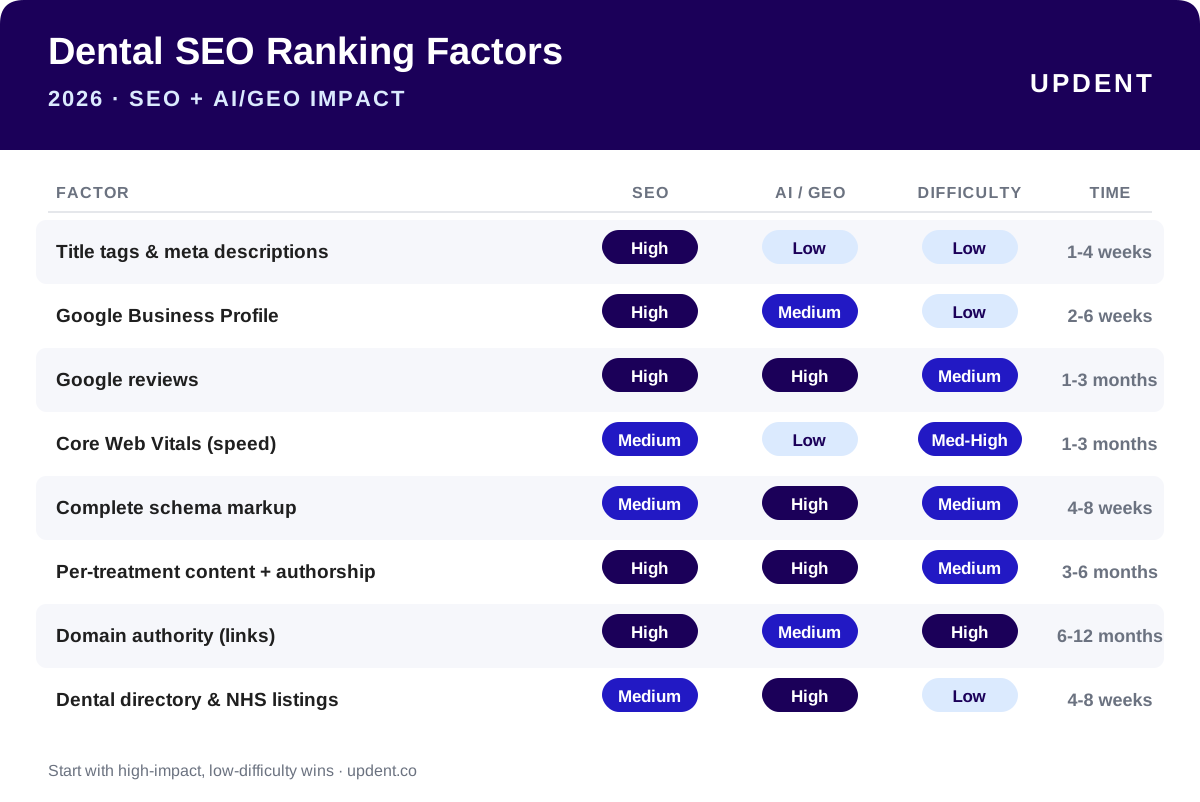
Summary table of factors — 2026:
| Factor | SEO impact | AI/GEO impact | Difficulty | Time to effect |
|---|---|---|---|---|
| Title tags and meta descriptions | High | Low | Low | 1-4 weeks |
| Google Business Profile | High | Medium | Low | 2-6 weeks |
| Google reviews | High | High | Medium | 1-3 months |
| Core Web Vitals (speed) | Medium | Low | Medium-High | 1-3 months |
| Complete schema markup | Medium | High | Medium | 4-8 weeks |
| Content per treatment with authorship | High | High | Medium | 3-6 months |
| Domain authority (links) | High | Medium | High | 6-12 months |
| Dental directory and NHS listings | Medium | High | Low | 4-8 weeks |
The reading of this table is the same as in previous years: start with high impact and low difficulty (GBP, title tags, schema, directories) to get quick wins while you build what takes longer.
If you want a step-by-step process for applying each of these factors, in our guide to improving dental SEO with a checklist you'll find the detail with each action in order.
On-page SEO for practices in 2026: how to optimise each page
The content architecture of a well-ranked practice in 2026 follows the same logic: one URL per treatment, one intent per page. What changes is that now each page must serve two audiences: the patient browsing, and the AI deciding whether to cite you.
URL structure by treatment
Each main treatment needs its own independent URL:
clinicx.co.uk/dental-implants/
clinicx.co.uk/orthodontics/
clinicx.co.uk/teeth-whitening/
clinicx.co.uk/dental-veneers/
clinicx.co.uk/root-canal/
The reason hasn't changed: Google ranks pages, not sites. If orthodontics and implants share a page, neither reaches the top because the semantic signal is split between two different intents. In 2026, that split also makes it harder for AIs to attribute specific topical authority to your content.
Title tag per treatment: the formula that works
Formula: [Treatment] in [City] | [Differentiator] | [Practice name]
Examples that work:
- "Dental Implants in London | Same-Day Implants | Practice X"
- "Invisible Orthodontics in Manchester | For Adults and Teens | Practice Y"
- "Teeth Whitening in Birmingham | Results in 1 Session | Practice Z"
The differentiator lifts CTR by between 15% and 25% because it makes your result stand out against the competition's generic titles. In an environment where AI Overviews compress the visible space of the SERP, that differentiator matters more than before.
Minimum content for a treatment page that ranks in 2026
A treatment page that wants to appear in the top results and be cited by AIs needs to cover these blocks:
- Explicit definition of the treatment in the first lines: "X is the procedure by which...". AIs use explicit definitions to classify content.
- Who it's for (candidates, general contraindications without entering individual diagnosis).
- What the process is like step by step, from the first consultation to discharge.
- Pricing information, indicative or an honest explanation of why it varies by case. Pages that include price ranges are more likely to appear in AI Overviews of comparison queries.
- Frequently asked questions with at least 5 real questions patients ask. They are the block AIs cite most.
- Visible authorship: name of the dentist who reviewed or wrote the content, GDC registration number and a link to their profile.
- Visible booking: phone, form or online booking button at the top and at the end of the page.
The minimum length is between 800 and 1,500 words depending on the keyword's competition. For implants in London you need more. For orthodontics in a smaller town, less may be enough.
Schema markup: essential in 2026
Schema markup is code you add to your site to tell Google exactly what each element of the page is. In 2026 it is also the structured language generative AIs read to decide whether they have enough information about your practice to recommend it.
The three essential schemas for a dental practice:
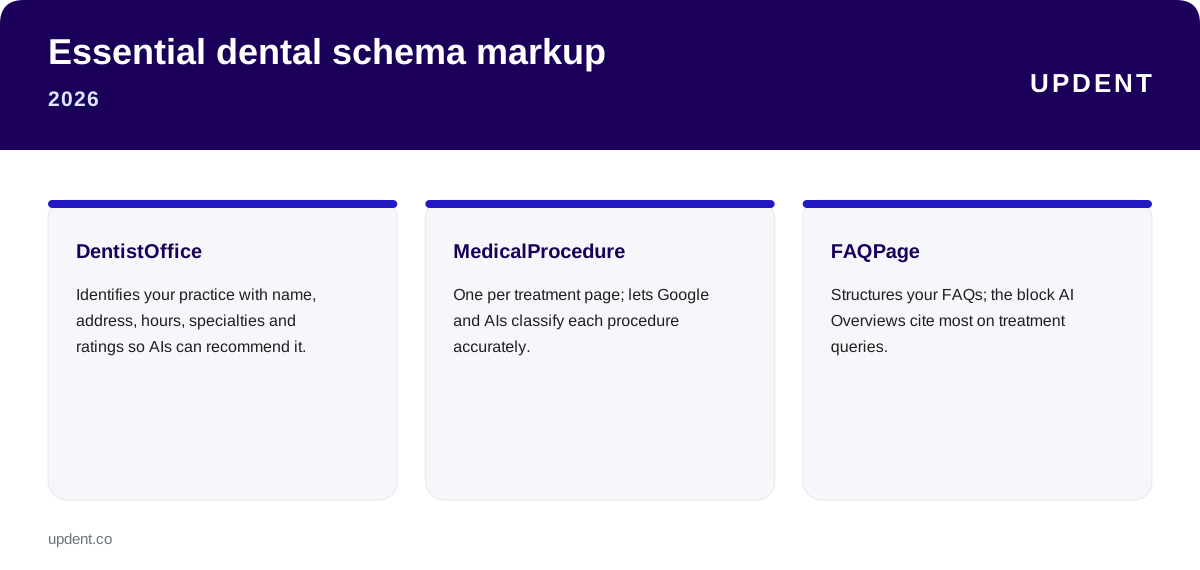
DentistOffice: indicates that your business is a dental practice with name, address, phone, opening hours, specialties and ratings. When well implemented, Google can show this information directly in the results. It is also the signal platforms like ChatGPT and Gemini use to identify your practice in local searches.
MedicalProcedure: one per treatment page. It tells Google and the AIs that the page describes a specific medical procedure, with its technical name, description and associated body text. Without it, AIs cannot classify the content accurately.
FAQPage: includes the frequently asked questions in structured format. When it works, Google can show those questions in the results in an expandable format. In 2026, FAQs in schema are also the block AI Overviews most frequently cite when answering informational queries about dental treatments.
Local SEO for dental practices: how to dominate Google Maps in 2026
There is a data point from BrightEdge that changes the strategic reading of local dental SEO in 2026: Google tested AI Overviews on local-intent searches ("dentist near me", "pediatric dentist near me", "dental practice London") and removed them entirely. 0% of those searches have an AI Overview as of December 2025.
What that means for your practice is concrete: the searches that generate patients who call and book remain the territory of the Maps pack and local organic SEO, with no AI competition. Investment in Google Business Profile and local ranking remains the investment with the highest direct return on patient acquisition.
80% of patients searching "dentist near me" choose between the three results that appear on the map before reaching the organic results. Getting into that pack depends on three factors according to Google: relevance (how relevant your listing is to the search), distance (physical proximity of the searcher) and prominence (the practice's overall online authority). You don't fully control the first two. The third, you do.
Google Business Profile: complete optimisation
Your Google Business Profile is the most underused digital asset of most dental practices. Filling it in well takes 2-3 hours and has a visible impact in 2-6 weeks.
Optimisation checklist updated for 2026:
- Primary category: "Dentist". Not "Dental clinic", not "Health centre". "Dentist" remains the category with the highest search volume.
- Secondary categories: Dental implants provider, Orthodontist, Pediatric dentist, Periodontist. Add all that match your real services.
- Photos: at least 20 quality photos. Professional team, waiting room, surgeries, exterior front, technology. Listings with more photos get more visibility in Maps. Before-and-after patient photos require explicit, written consent.
- Opening hours: kept up to date, including bank holidays and special holiday hours. A listing with incorrect hours breeds distrust and negative reviews.
- Services: list each treatment with a short description. This increases the listing's relevance for specific searches like "dental implants London", not just "dentist London".
- Google Business posts: publish at least 2 posts a month with news, oral hygiene reminders or treatment information. It is a signal of activity Google values.
- Questions and answers (Q&A): add the questions patients ask yourself and answer them before they arrive. If you don't, any user can answer in your name.
Reviews: the number 1 conversion factor
A practice with 4.8 stars and 80 reviews consistently beats a practice with 5 stars and 6 reviews. The reason is psychological: more reviews means more real patients who validated the experience. In 2026, reviews are also the trust signal generative AIs use to determine a practice's reputation when someone asks about it outside Google.
How to get reviews ethically and consistently:
- At the end of the appointment, when the experience is fresh, the receptionist mentions that a review helps the practice a lot.
- 48 hours after the first visit, a WhatsApp or SMS with the direct link to the Google listing. The conversion rate is between 15% and 30%.
- A poster in the waiting room with a QR code that goes straight to the review form.
- Never offer discounts or gifts in exchange for reviews. Google penalises it and can remove all of the practice's reviews.
- Always respond to reviews, positive and negative. The response to a negative one isn't to convince the person who left it: it's to show the rest of your potential patients how your practice handles problems.
NAP consistency: the detail almost nobody looks after
NAP stands for Name, Address, Phone. Google verifies that this information is identical everywhere you appear: your website, your Google Business Profile, NHS Find a Dentist, dental directories and any local listing sites.
A single discrepancy (the name abbreviated in one place and full in another, the phone with or without area code) generates contradictory signals that Google interprets as uncertainty about the business identity. The impact on local ranking can be significant. Auditing it takes less than an hour. Correcting it, the same. The effect on local ranking shows in 4-8 weeks.
You can see how we work on local ranking with practices in our local SEO for dental practices service.
AI Overviews and dental SEO: what has really changed in 2026
AI Overviews are the summaries generated by artificial intelligence that Google places at the top of the search results before showing any link. They rolled out in the UK in 2025 and since then have transformed the distribution of organic traffic in several sectors.
For the dental sector, the December 2025 data is clear: queries about treatments and procedures have 100% AI Overview coverage. When a patient searches "how does a dental implant work" or "how long does an invisible orthodontics treatment last", Google answers directly with an AI-generated summary, before showing any practice or any blog.
That doesn't mean your content is no longer useful. It means its function has changed.
The informational content of your website no longer competes primarily for the click of the patient asking what a treatment is. It competes to be the source Google cites within that summary. And being cited has a double value: visibility for the patient reading the summary, and a topical authority signal that reinforces your ranking across the rest of the searches.
The data point that completes the picture: according to BrightEdge data, Google removed AI Overviews entirely from searches with local medical-visit intent. Searches like "dentist near me" or "dental practice in my area" show no AI summary. The Maps 3-pack and local organic results remain the only format for these searches.
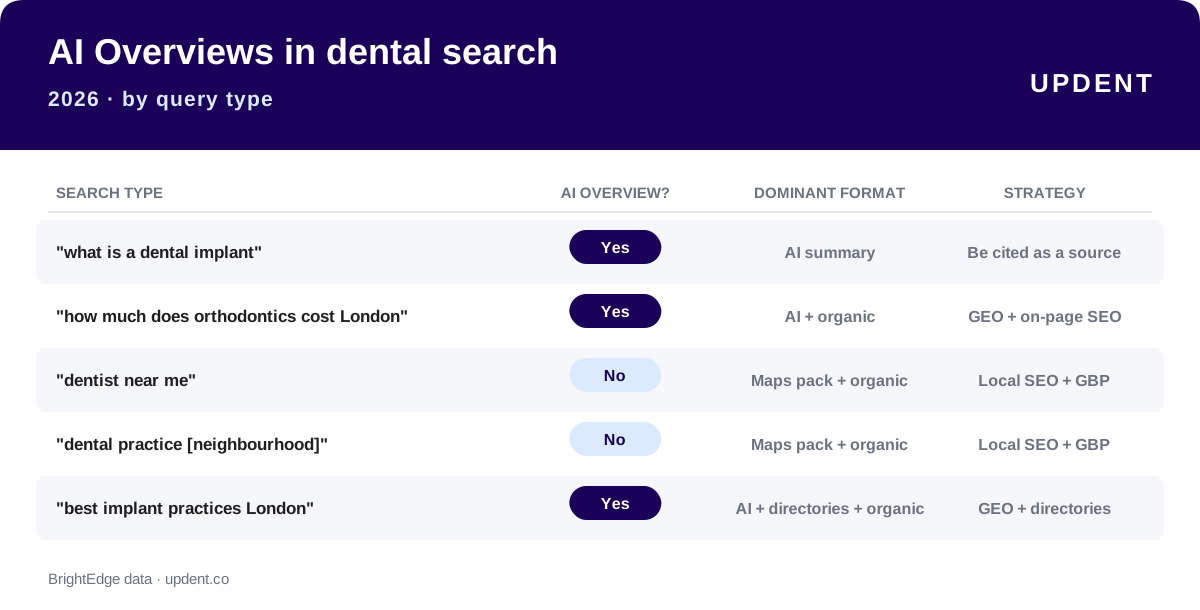
That creates a clear strategic division:
| Type of dental search | AI Overview? | Dominant format | Strategy |
|---|---|---|---|
| "what is a dental implant" | Yes (100%) | AI summary | Optimise to be cited as a source |
| "how much does orthodontics cost London" | Yes (high presence) | AI + organic results | GEO + on-page SEO |
| "dentist near me" | No (0%) | Maps pack + organic | Local SEO + GBP |
| "dental practice [neighbourhood]" | No (0%) | Maps pack + organic | Local SEO + GBP |
| "best implant practices London" | Yes (high presence) | AI + directories + organic | GEO + directory presence |
GEO for dental practices: how to appear in ChatGPT, Gemini and AI Overviews
GEO (Generative Engine Optimization) is the practice of optimising your practice's presence so AI systems cite you as a trustworthy source in their answers. It doesn't replace SEO: it complements it.
In 2026, the traffic arriving through AIs still represents a small fraction of total visits, but converts at a significantly higher rate than conventional organic traffic. According to almcorp data, visitors referred by AI platforms spend 68% more time on sites and convert at rates between 4 and 23 times higher than traditional organic traffic. Whoever builds AI visibility today, while the dental competition still isn't doing it, will have an advantage when that traffic scales.
How an AI decides which practice to recommend
Generative AIs don't run a new search every time you ask them. They answer based on what they indexed from the internet: high-authority health sites (dental directories, NHS resources, medical press), well-structured own content with schema markup, and consistency of information across your entire online presence.
If your practice has an incomplete profile in the main dental directories, isn't on NHS Find a Dentist and its website has no DentistOffice schema, the AIs don't have enough data to recommend you, even if you're an excellent practice.
To appear in Google's AI Overviews there is an additional factor: the content Google cites in its summaries tends to be well-positioned in the classic organic ranking. On-page SEO remains the foundation. GEO optimises to be cited once you already have visibility.
4 concrete actions to improve your practice's GEO in 2026
1. Complete your profiles to 100% on the main dental directories and NHS Find a Dentist. A detailed description of each dentist on the team with qualifications and years of experience, specialties, professional photos and answers to the platform's frequently asked questions. AIs value the richness and consistency of the information.
2. Use explicit definitions in your website content. Phrases like "a dental implant is a titanium screw that..." or "invisible orthodontics is a system of clear aligners that..." are the kind of construction AIs use to extract definitions. Without them, the content is harder to cite accurately.
3. Implement complete DentistOffice schema on your site, with all the fields: practice name, address, phone, URL, specialties with the medicalSpecialty field, geographic service area (areaServed), opening hours and aggregate ratings. This schema is literally the structured language AIs read best.
4. Get external authority sources to mention your practice by name and specialty. An appearance in the local press about a success story, an interview on a health site, or a listing in NHS Find a Dentist are signals AIs read as external validation. In 2026, a mention in an authority source carries as much weight as, or more than, a classic backlink.
If you want to go deeper into the full strategy, in our article on GEO for dental practices and presence in ChatGPT and Gemini you'll find the step-by-step process.
How long does SEO take to deliver results for a dental practice in 2026?
The honest answer still has two parts.
The first: some effects show in weeks. A title tag change on a page with impressions in Google can generate more clicks in 1-3 weeks. Optimising the Google Business Profile can take the practice into the local 3-pack in 2-6 weeks if the competition isn't strongly positioned.
The second: consolidated organic SEO takes between 6 and 12 months. Every article published, every review received, every link earned adds authority that doesn't disappear. What changes in 2026 is that part of that accumulated authority also determines whether the AIs cite you, not just whether Google ranks you.
Realistic timeline by phase in 2026
Months 1-2 (technical and local foundation):
- Technical audit and error correction (speed, mobile, DentistOffice schema).
- Optimisation of title tags and meta descriptions on all existing pages.
- Google Business Profile at 100%, including regular posts.
- NAP correction across all directories.
- Complete profiles on dental directories and NHS Find a Dentist with authorship for each dentist.
- Review capture system via WhatsApp.
- Expected results: CTR improvement on existing pages, first rises in Maps.
Months 3-6 (content and organic ranking):
- Individual treatment pages created with MedicalProcedure schema, FAQPage and visible authorship.
- First blog articles published with Answer Capsule structure, explicit definitions and FAQs.
- Expected results: treatment pages entering the first 3 pages of Google, first appearances as a source in AI Overviews for informational searches.
Months 6-12 (consolidation and scale):
- Pillar articles ranking on page 1 and being cited in AI Overviews.
- First authority links (directories, NHS listings, local press).
- Expected results: stable positions in the top 5-10 for the main keywords, consistent organic traffic with first documented AI citations.
SEO vs Google Ads in 2026: the right sequence
| SEO | Google Ads | |
|---|---|---|
| First results | 3-6 months | Immediate |
| Cost once ranked | 0 per click | Pay for every click |
| What happens when you stop | You keep appearing | You vanish instantly |
| Effect on AI Overviews | High (medium term) | None |
| Ideal for | Sustainable growth | Launch or immediate urgency |
The most efficient strategy for a new practice or one wanting to grow fast is still the same: use Google Ads while SEO grows, and gradually reduce Ads spend as organic generates its own traffic. They aren't competitors, they're complementary in different phases.
What has changed is the usefulness of each channel for AI visibility: AI Overviews don't cite ads. They only cite organic content. Building content authority with SEO is the only way to gain presence in that space.
Real case: from invisible website to 1,400 organic visits and first AI Overview citations
This is the real situation of a dental practice we work with at Updent. Greater Manchester area, 3 chairs, specialising in implants and orthodontics, a team of 4 dentists.
Starting situation (month 0):
- 2018 website never updated, 7-second load time on mobile.
- 0 reviews on Google. Google Business Profile with no photos, category "Medical centre" instead of "Dentist".
- No individual treatment pages: a single "Services" page with a paragraph per treatment.
- Organic traffic: 180 visits a month, almost all branded.
- 0 positions in the local 3-pack for any treatment keyword.
Actions, months 1-3:
- Migration to a faster server and image compression. Core Web Vitals went from red to green.
- Google Business Profile optimised to 100%: correct category, 25 photos, opening hours, detailed services, Q&A completed.
- DentistOffice schema implemented.
- Review capture system via WhatsApp: 34 reviews in 10 weeks.
- Title tags and meta descriptions rewritten on all pages.
- Profiles for each dentist on the main dental directories and NHS Find a Dentist at 100%.
Actions, months 4-7:
- Individual pages created for implants, orthodontics, whitening, veneers and root canal. Between 900 and 1,400 words each with MedicalProcedure schema, FAQPage and visible dentist author name.
- Pillar article "How much does a dental implant cost in Manchester: real prices" (2,800 words with explicit definitions and an indicative price table). It ranked in the top 8 in 11 weeks and started appearing cited in AI Overviews for implant-price searches in Manchester.
- Complete directory listing with an individual profile for each dentist.
Results at month 10:
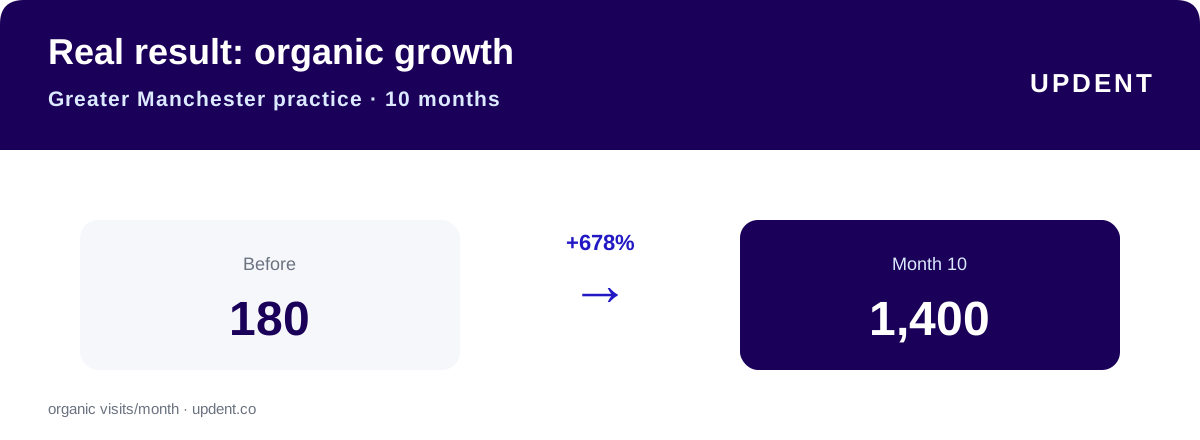
- Organic traffic: from 180 to 1,400 visits a month (+678%).
- Local 3-pack: 2 of its 3 main implant keywords in Manchester.
- Average position for "dental implants Manchester": position 7 (previously didn't appear in the first 5 pages).
- Appearance as a cited source in AI Overviews for 3 informational implant searches in Manchester.
- First organic enquiries attributable to SEO: 18-22 a month.
- The SEO investment paid back in month 7.
You can see more similar results in our practice case studies.
Conclusion: where to start your dental practice's SEO in 2026
Dental SEO in 2026 runs on two tracks. The local searches that generate patients who call and book remain the territory of Google Maps and local organic SEO, with no AI in between. The informational searches about treatments are dominated by AI Overviews, and the goal there is no longer the click: it's being cited as a source.
The factors that move the result most remain the Google Business Profile, reviews, content per treatment with visible authorship, schema markup and the technical health of the site. The first effects show in weeks. The consolidated results, in 6-12 months.
There is no universal starting point because every practice has its own specific problems: some have a slow website, others have no reviews, others have no treatment content, others aren't listed on NHS Find a Dentist. The first step is always an honest audit of where you stand.
At Updent we do that audit in 30 minutes, free and with no commitment. We review your current situation in local SEO, content and AI visibility, and we tell you exactly what is holding back your practice's patient acquisition and what to do first.
Frequently asked questions about SEO for dental practices
What is SEO for dental practices and how does it differ from general SEO?
SEO for dental practices is the set of web ranking actions adapted to the particularities of the dental sector: Google's YMYL classification (which demands stricter E-E-A-T criteria), the patient's triple search intent (inform, compare and decide locally), competition from health and dental directories, and the regulatory restrictions on healthcare advertising in the UK (GDC and ASA). A generic SEO strategy doesn't cover these specific factors and usually delivers worse results than a strategy adapted to the sector.
How long does dental SEO take to deliver real results in 2026?
The first effects show in 2-6 weeks if you start with Google Business Profile optimisation and title tags, which have immediate impact without moving the ranking. Consolidated organic results, with stable positions for the main keywords, take between 6 and 12 months. The variables that speed up the process are: a city with moderate competition, a technically healthy website from the start, a domain over 2 years old, and a practice with existing reviews.
What are Google's AI Overviews and how do they affect my dental practice's SEO?
AI Overviews are summaries generated by artificial intelligence that Google places above the organic results on informational searches. For the dental sector, they cover 100% of queries about treatments and procedures (BrightEdge data, December 2025). This means your website's treatment pages no longer compete only for the organic click: they also compete to be cited as a source within the AI summary. The good news is that the local searches that generate patients ("dentist near me", "dental practice London") don't have AI Overviews: Google removed them entirely from those queries.
How many reviews does my dental practice need on Google to rank well?
There is no fixed minimum, but from 50 reviews with an average of 4.5 or higher the practice starts to compete seriously in the Maps pack for most mid-sized UK towns. In large cities or metropolitan areas, the pack leaders usually have between 80 and 200 reviews. The frequency of new reviews matters as much as the accumulated total: a practice with 30 reviews from the last 6 months competes better than one with 100 from 3 years ago and none recent.
Do I need a separate page for each treatment or can I have a "services" page?
You need a separate page for each main treatment. A "services" page with a paragraph per treatment doesn't rank because Google indexes pages, not sites. If orthodontics and implants share a page, neither reaches the top because the semantic signal is split between two different search intents. Each treatment page must have its own URL, its own title tag, its own content of at least 800 words and its own MedicalProcedure schema.
Frequently Asked Questions
SEO for dental practices is the set of web ranking actions adapted to the particularities of the dental sector: Google's YMYL classification (which demands stricter E-E-A-T criteria), the patient's triple search intent, competition from health and dental directories, and the regulatory restrictions on healthcare advertising in the UK (GDC and ASA).

José Ramón Díaz
+10 años de experiencia en Marketing y Startups especializado en el sector Salud y Dental. Ex-DR SMILE e Impress.
Want us to implement
this in your practice?
Book your free audit and we'll show you exactly how to grow.
Talk to a Strategist